
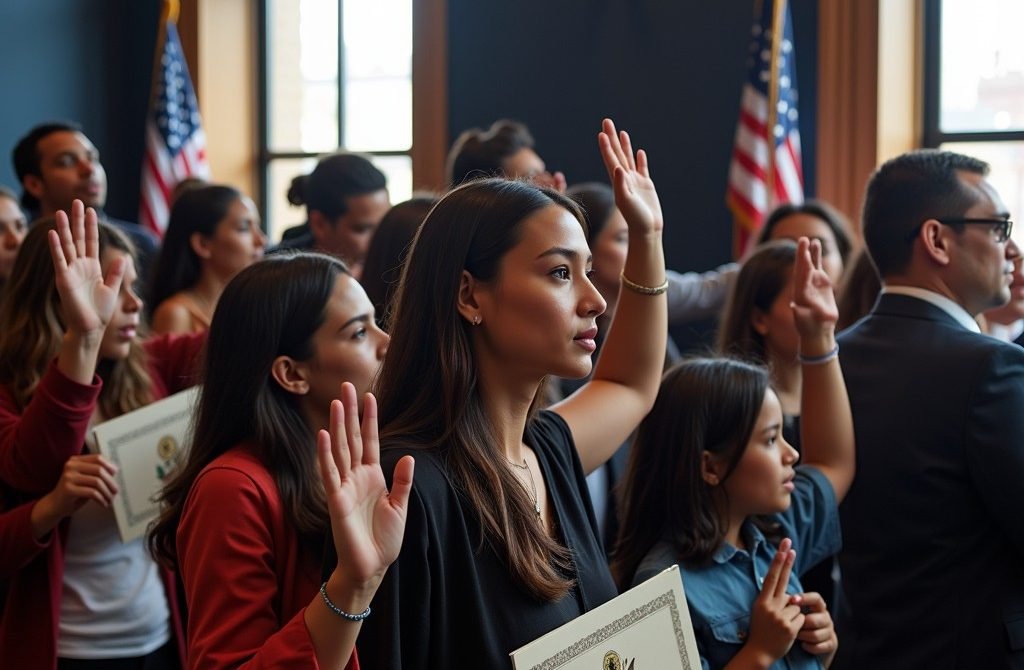
What happens during the naturalization interview?
During your naturalization interview, a U.S. Citizenship and Immigration Services (USCIS) officer reviews your application, asks questions about your background and eligibility, and administers the required tests.
For most applicants, the interview includes three main components:
- N-400 application review: Questions about your personal information, travel, family, immigration history, and naturalization eligibility.
- English test: Speaking, reading, and writing assessments unless you qualify for an exemption.
- Civics test: Oral questions about U.S. government, history, and civic principles unless you qualify for an exemption or exception.
The officer may request additional information or documents if needed. Preparing for the interview means understanding your application as well as studying civics questions. You can review the USCIS official interview guidance to understand the process.
Step 1Confirm which citizenship civics test applies to you
Do not assume that every applicant takes the same version of the civics test. USCIS introduced the 2025 Naturalization Civics Test for applicants who file Form N-400 on or after October 20, 2025. Applicants who filed before that date generally take the 2008 version. If you are applying in 2026, you will most likely take the 2025 test.
| Test version | Questions asked | Passing score |
|---|---|---|
| 2008 test | Up to 10 from a list of 100 | 6 correct |
| 2025 test | Up to 20 from a list of 128 | 12 correct |
| 2025 test, qualifying 65/20 applicants | 10 from 20 designated questions | 6 correct |
How the 2025 test ends: The officer does not necessarily ask all 20 questions. The test stops once you answer 12 questions correctly, which means you pass, or once you answer 9 incorrectly, which means you do not pass that attempt. The test may end before the 20th question.
The 65/20 provision is a special consideration for qualifying applicants aged 65 or older who have been lawful permanent residents for at least 20 years. It is not a separate general test version.
Confirm your filing date and use the corresponding official question list before studying. The two main versions have different question banks and testing formats.
Step 2Follow a practical citizenship test study plan
You do not need to master everything in one sitting. A short, consistent routine can help you remember information and identify what needs more practice.
A seven-day preparation plan
- Day 1Confirm your test version.Check your filing date, download the correct USCIS question list, and note any exemption that may apply.
- Day 2Study American government.Focus on the Constitution, the branches of government, rights, and responsibilities.
- Day 3Study American history.Review the historical events, founding documents, people, and principles included in your official study materials.
- Day 4Review integrated civics.Study geography, national symbols, and related topics.
- Day 5Test yourself.Use flashcards or ask someone to quiz you without showing you the answers first.
- Day 6Practice aloud.Simulate the oral civics test and review the questions you answered incorrectly.
- Day 7Prepare for the interview.Review your N-400, organize your documents, and check your appointment notice.
Seven days is a suggested schedule, not a requirement. If your interview is more than a week away, repeat the cycle. Short daily sessions and regular self-testing are often more useful than one long study session.
Step 3Practice citizenship civics test questions
These examples are drawn from the official 2025 civics test study material. They are practice questions, not a prediction of what your officer will ask. If you are taking the 2008 test, use the appropriate official question bank instead. Try answering aloud before you tap to reveal each answer.
Question 1What is the supreme law of the land?Tap to reveal the answer
Answer: The Constitution.
Why it matters: Federal and state laws must be consistent with the Constitution. It is the foundation the rest of the government is built on.
Question 2What does the Constitution do?Tap to reveal the answer
Answer: Any one of these is acceptable: sets up the government, defines the government, or protects the basic rights of Americans.
Why it matters: Learn the official acceptable answers, not just one phrase you have heard elsewhere.
Question 3Name one branch or part of the government.Tap to reveal the answer
Answer: Congress, the President, or the courts.
Why it matters: The federal government has legislative, executive, and judicial branches. Understanding this structure helps with several related questions.
Question 4What is one right or freedom from the First Amendment?Tap to reveal the answer
Answer: Speech, religion, assembly, press, or petition the government.
Why it matters: You only need one acceptable answer. Choose one you can say clearly and confidently.
Question 5What is the highest court in the United States?Tap to reveal the answer
Answer: The Supreme Court.
Why it matters: The Supreme Court sits at the top of the judicial branch. Knowing its role connects to questions about the courts and checks and balances.
Question 6What ocean is on the West Coast of the United States?Tap to reveal the answer
Answer: The Pacific Ocean.
Why it matters: Geography questions are part of integrated civics. Learning the Pacific (West Coast) and Atlantic (East Coast) together makes both easier to remember.
For the complete list and accepted answers, use the official 2025 Civics Test Questions and Answers.
How to practice effectively
- Say the answers aloud rather than only reading them.
- Practice with someone who can ask questions in a random order.
- Keep a list of questions you miss. Review those first in your next session, then test yourself again without looking at the answers.
- Learn the meaning of each answer rather than relying exclusively on memorization.
- Check answers that may change because of elections or appointments.
Some answers depend on your state or congressional district. Others, such as the names of current officeholders, can change. Check USCIS test updates before your interview.
Step 4Prepare for the English test
Unless you qualify for an exemption or exception, you must demonstrate English speaking, reading, and writing skills.
- Speaking: The officer evaluates your English through the conversation and questions about your N-400.
- Reading: You must read one sentence correctly. USCIS gives up to three attempts.
- Writing: You must write one sentence correctly. USCIS gives up to three attempts.
Practice reading short sentences aloud, writing sentences from dictation, and answering questions about your application in your own words.
You do not need to memorize a script for the interview. Focus on understanding the questions and responding honestly.
Step 5Review your N-400 application
Before the interview, read the application you submitted to USCIS. Be prepared to discuss your answers and explain any relevant changes since filing.
Pay particular attention to:
- Your addresses and employment history.
- Your travel outside the United States.
- Your marital and family information, where applicable.
- Your immigration history.
- Your answers to eligibility and background questions.
- Any changes since you filed your application.
If you discover an error or a change that could affect your eligibility, make a note of it and consider obtaining legal guidance before the interview. Do not guess about how to address a potentially significant issue. At the interview, answer the officer truthfully, and ask for clarification if you do not understand a question.
Step 6Know what documents to bring
Follow the instructions in your USCIS interview notice. USCIS generally instructs applicants to bring:
- Their interview appointment notice.
- Their Permanent Resident Card (Green Card).
- A state-issued photo identification document, such as a driver's license.
- All valid and expired passports and travel documents that document absences from the United States since becoming a permanent resident.
Your circumstances may require additional documents. Check the official USCIS naturalization interview guidance and any specific requests included in your notice. Organize your documents in advance so you can find them easily, and do not assume the general list covers every case.
Step 7Check whether an exemption or exception may apply
Some applicants qualify for an exemption from the English test or special consideration for the civics test.
Under the age-and-residency rules, applicants who meet the relevant requirements may qualify for the following:
These exemptions depend on meeting the applicable requirements, including the relevant timing rules. Applicants who take the civics test in their chosen language must meet USCIS interpreter requirements.
A person with a qualifying physical or developmental disability or mental impairment may also be eligible for an exception to the English and/or civics requirements. This requires Form N-648, Medical Certification for Disability Exceptions, completed by an appropriately qualified medical professional. USCIS updated its guidance in 2025 to strengthen its review of these requests, so a complete, carefully prepared medical certification matters.
Read the official USCIS exceptions and accommodations guidance before relying on an exemption or exception.
What has changed in naturalization review
Beyond the new civics test, USCIS has changed how it reviews some naturalization applications. These changes do not affect most applicants' study plans, but they are worth understanding before you file or attend your interview.
Neighborhood investigations. For decades, USCIS generally waived the in-person "neighborhood investigations" it is authorized to conduct under the law. In August 2025, USCIS ended that general waiver, and in August 2026 it formalized the change in its Policy Manual. USCIS now decides case by case whether an investigation is needed. When one is conducted, it may look at your residence, employment, and reputation in your community, generally covering at least the five years before you filed.
This does not mean every applicant will be investigated. USCIS considers the evidence you submit when deciding whether to waive an investigation, including voluntary reference letters from neighbors, employers, or community members.
What this means for you: Make sure the addresses, employment history, and other details in your N-400 are accurate and consistent with your records. If you are still preparing your application, ask whether supporting letters make sense in your circumstances.
How citizenship can change your family's immigration options
Naturalization is often about more than your own status. Becoming a U.S. citizen can open or speed up immigration options for the people you love.
- Spouses and unmarried children under 21: If you filed a petition for them as a permanent resident, it generally converts to the "immediate relative" category when you naturalize. Immediate relatives are not subject to the annual limits that create long family-preference waits.
- Unmarried sons and daughters 21 or older: Their petition generally moves from the F2B category to F1. In some cases, the beneficiary can choose to keep the original category if that would be faster.
- Parents: U.S. citizens who are 21 or older may petition for their parents as immediate relatives. Permanent residents cannot.
- Married sons and daughters and siblings: Only U.S. citizens can petition in these categories. Sibling petitions also require the citizen to be 21 or older. See how long the F3/F4 backlog takes in 2026.
Which option applies, and how long it may take, depends on your family's circumstances. Learn more on our family-based petitions page.
How YFIL helps naturalization applicants
You can prepare for the civics test on your own. Many applicants do. Where we help is with the parts general study materials cannot answer for you.
- Before you fileWe review your immigration history, travel, and background answers so you understand how they may affect your eligibility and which civics test will apply.
- If something in your history needs explanationWe help you understand which facts matter, what they may mean, and how to address them accurately, without judgment.
- Before your interviewWe walk through your N-400 with you so you know what the officer may ask and can answer clearly and honestly.
- Looking aheadWe explain how citizenship may affect any pending or future petitions for your spouse, children, parents, or siblings.
Our goal is simple: you should walk into your interview understanding your own application and knowing what comes next. Read more about our approach and our citizenship and naturalization services.
Frequently asked questions
How many questions are on the citizenship test in 2026?
The applicable version generally depends on your N-400 filing date. The 2008 test asks up to 10 questions from a list of 100, requiring six correct answers. The 2025 test asks up to 20 questions from a list of 128, requiring 12 correct answers. The 2025 test ends early once you reach 12 correct or 9 incorrect answers.
What happens if I fail the English or civics test?
USCIS generally provides a second opportunity to take the portion of the test you failed, usually within 60 to 90 days of the initial interview. You are retested only on the failed portion or portions. If you do not pass the retest, USCIS may deny the application. Check your notice and current USCIS guidance for the requirements that apply to your case.
Can I take the civics test in my native language?
You may be able to if you qualify for an English exemption based on age and years as a lawful permanent resident, or if an approved medical exception applies to the English requirement. Interpreter requirements apply. Check the current USCIS guidance for your circumstances.
Will USCIS visit my neighborhood or employer?
Possibly, but not automatically. USCIS decides case by case whether a neighborhood investigation is needed, based in part on the evidence submitted with your application. Accurate information and supporting documentation can help.
How long should I study for the citizenship test?
There is no single study period that works for everyone. Use the correct official question list, practice aloud, and give extra attention to questions you consistently miss. Allow more time if you are also preparing for the English test.
Preparing for your citizenship interview? Understand your options.
Preparing for naturalization involves more than memorizing civics answers. You also need to understand your application, know which testing requirements apply to you, and be ready to provide any requested information.
If you have questions about your eligibility, your immigration history, a potential testing exemption, or how citizenship may affect your family's petitions, general study materials may not address your individual circumstances.
Have questions about your eligibility? Contact YFIL for a free case review.
Schedule a Free ConsultationTell us what is happening. We'll discuss your circumstances, your potential options, and whether our firm may be able to help.
Legal information note: This article provides general educational information, not individualized legal advice. Naturalization requirements, test procedures, and USCIS guidance may change. Verify current requirements using official USCIS resources and seek advice from a qualified immigration attorney about your particular circumstances.
